President Donald Trump isn’t saying he will declare a national security emergency involving the 2026 midterm elections.
But when the idea was presented to him Tuesday, he didn’t exactly slam the door on it.
“Stranger things have happened.”
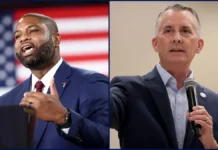
That was Trump’s response during an interview aired on Real America’s Voice’s America Speaks, after host Wayne Allyn Root proposed using emergency presidential authority to impose nationwide election requirements if Congress fails to act.
He suggested Trump could declare a national security emergency and use it to require photo identification for voting, proof of citizenship and restrictions on mail-in ballots.
Root argued that the 1983 Supreme Court decision Immigration and Naturalization Service v. Chadha would protect such an emergency declaration from ordinary congressional reversal.
“If they never get the Save America Act done, you have the right to declare a national security emergency for elections,” Root told Trump.
He claimed that under Chadha, Congress could overturn such a declaration only with a two-thirds vote in both chambers.
Trump didn’t endorse the legal theory outright.
“Let me just say that stranger things have happened, okay?” he responded. “I’ll leave it at that.”
It was classic Trump ambiguity: no commitment, no detailed legal argument and certainly no rejection.
There is, however, a substantial problem with Root’s description of the law.
INS v. Chadha did not rule that a president can declare a national security emergency that Congress is powerless to challenge except through two-thirds votes in both chambers. The case concerned the legislative veto, a mechanism that allowed one chamber of Congress to overturn certain executive actions without passing new legislation through the normal constitutional process.
🚨🚨🚨
WAYNE ALLYN ROOT: You have the right to declare a national security emergency for elections. If you do this in the next month, we will get photo ID, proof of citizenship, and a limit to mail ballots
TRUMP: Let me just say stranger things have happened. I’ll leave it at… pic.twitter.com/SvXYoYI0lQ
— Aaron Rupar (@atrupar) August 11, 2026
The Supreme Court held that arrangement unconstitutional because congressional legislative action generally must satisfy bicameralism and presentment — passage by both houses followed by presentation to the president.
That is not the same thing as giving presidents an unreviewable power to declare election emergencies.
The distinction matters enormously when discussing federal elections.
The Constitution divides election authority among states, Congress and the federal government in specific ways, and any attempt by a president to unilaterally rewrite election rules would almost certainly trigger immediate litigation over both statutory and constitutional authority.
So Trump’s answer is politically noteworthy. Root’s description of what Trump could legally accomplish through an emergency declaration should not be treated as settled law.
The conversation comes as Trump and congressional Republicans push for the SAVE America Act, which contains major changes to federal election rules, including voter-identification and proof-of-citizenship provisions and restrictions on universal mail voting.
The legislation stalled before the Senate left Washington for its August recess.
Under current Senate rules, Republicans would need enough support to overcome a filibuster. With Democrats overwhelmingly opposed, that presents the same arithmetic problem confronting much of the Republican legislative agenda.
Trump has already called on Republicans to eliminate the filibuster and remain in session to pass the measure.
The Senate didn’t follow his recommendation before leaving for recess.
That legislative stalemate explains why the emergency-power question is now being floated.
But wanting Congress to pass a law and possessing unilateral presidential authority to impose the same policy are two very different things.
Voter identification itself remains broadly popular in many surveys, while the details of citizenship documentation and mail-ballot restrictions generate considerably more political and legal disagreement. States also already maintain their own election systems under a mixture of state and federal requirements.
A presidential attempt to override those systems by declaring a national security emergency would therefore be no minor executive action.
It would create an immediate constitutional confrontation.
For the moment, Trump hasn’t announced that he intends to create one.
He was presented with an extraordinary proposal and offered an extraordinarily Trump-like answer.
“Stranger things have happened.”