Alabama Republicans received a major victory Monday after the U.S. Supreme Court cleared the way for the state to move forward with congressional redistricting that could ultimately flip two Democrat-held seats into GOP territory ahead of the 2026 midterms.
In a 6-3 decision, the Supreme Court vacated a lower court ruling that had forced Alabama to maintain two majority-black congressional districts under prior interpretations of the Voting Rights Act.
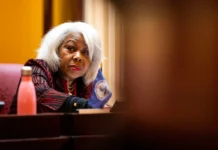
The ruling directly impacts the districts currently represented by Democratic Reps. Terri Sewell and Shomari Figures.
The decision follows the Supreme Court’s recent ruling in Louisiana v. Callais, a landmark case that sharply restricted the use of race as the dominant factor in congressional mapmaking and effectively dismantled much of the legal framework previously used to challenge Republican-drawn maps across the South.
Liberal Justices Sonia Sotomayor, Elena Kagan, and Ketanji Brown Jackson dissented from Monday’s Alabama decision.
Rather than issuing a final map itself, the Supreme Court ordered lower courts to reconsider Alabama’s congressional boundaries in light of the new legal standards established in the Louisiana ruling.
Republican Gov. Kay Ivey had already signaled the state was prepared to act quickly if the courts handed down favorable decisions.
Last week, Ivey said Alabama stood “ready to quickly act” on redistricting if legal obstacles were removed.
The state now plans to revert to maps previously approved by the Republican-controlled Legislature, including congressional district lines adopted in 2023 and state senate maps drawn in 2021.
Alabama’s primary elections scheduled for May 19 are expected to proceed as planned. However, under recently enacted state law, Ivey now has authority to call special elections later if district boundaries change following redistricting.
The ruling is part of a much larger nationwide redistricting battle that has intensified dramatically heading into the 2026 midterms.
Republicans are aggressively redrawing maps in multiple states after recent Supreme Court decisions weakened federal restrictions on partisan redistricting and race-based district requirements.
So far, the GOP appears to be gaining the upper hand.
Republicans potentially stand to gain as many as 14 additional House seats through ongoing or planned redistricting efforts in states including Texas, Missouri, North Carolina, Ohio, Florida, Tennessee, and now Alabama.
Democrats, meanwhile, are pursuing their own redistricting pushes in states such as California and Utah, though current projections suggest they may net only around six additional seats.
The stakes are enormous because even relatively small map changes could determine control of the House of Representatives for the remainder of Trump’s second term.