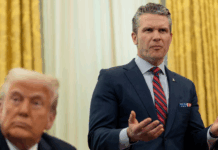
President Donald Trump pulled no punches Saturday, delivering a searing warning to Colombian President Gustavo Petro during a press conference dominated by the fallout from the successful U.S. military operation that brought down Venezuelan strongman Nicolás Maduro. The message was unmistakable: if you’re producing cocaine and sending it to the United States, you’re on notice — no matter what office you hold.
Trump’s direct accusation was a flashpoint: “He has cocaine mills. He has factories where he makes cocaine… he does have to watch his ass.” The remark, aimed squarely at Petro, followed earlier warnings dating back to December, when Trump first named Colombian production sites and advised the Colombian leader to “close up those cocaine factories.”
These aren’t hollow threats. The Trump administration’s tone and posture toward Petro — a self-proclaimed Marxist and ex-guerrilla fighter — have hardened considerably since January. Petro, already sanctioned by the U.S. Treasury and stripped of his visa for inciting mutiny among U.S. military personnel, has increasingly been portrayed by Trump and his allies as both ideologically hostile and strategically dangerous.
The diplomatic cold war has now moved into open confrontation.
Trump’s remarks came in the aftermath of Operation Absolute Resolve, a highly coordinated military and law enforcement operation that saw U.S. forces capture Nicolás Maduro and his wife, Cilia Flores, in a near-flawless raid that left zero American casualties. Both are now in U.S. custody and facing federal charges that include narco-terrorism, cocaine trafficking, and weapons violations.
President @realdonaldtrump explains why he believes rebuilding and running Venezuela is in the best interests of America. pic.twitter.com/iUwxUkq8gM
— Breitbart News (@BreitbartNews) January 3, 2026
But the real crux of the story lies in what the Maduro indictment revealed — a sophisticated, continent-wide narcotics pipeline allegedly run through military channels, intelligence networks, and partnerships with groups like the FARC, ELN, and major Mexican cartels. Maduro didn’t just tolerate the drug trade — he weaponized it, creating a shadow alliance of anti-American criminal states and non-state actors designed to destabilize the Western Hemisphere while enriching their regimes.
Colombia, under Petro’s leadership, finds itself awkwardly close to that nexus. Despite attempting to rhetorically distance himself from Maduro in late 2025 by finally acknowledging him as a “dictator,” Petro has never accepted the extensive narco-trafficking evidence marshaled against Maduro by U.S. prosecutors. Instead, he’s dismissed it as a “narrative,” a term often used to deflect without refuting.
But narratives don’t yield 2020 federal indictments, satellite-verified drug routes, and decades of coordinated surveillance.
Petro’s radical anti-American posture — including his call for international military disobedience to U.S. orders — hasn’t helped his case. Neither has his incendiary rhetoric about Trump, including his now-infamous “snap” gesture suggesting that “humanity should get rid of Trump,” which sparked bipartisan outrage in Washington. He may no longer be defending Maduro publicly, but he has yet to seriously address the intertwined networks of cocaine production, insurgency, and state corruption that continue to thrive within Colombia’s borders.
Trump’s Saturday statement marks a definitive shift: the era of diplomatic patience with narco-sympathetic leaders is over. His approach is grounded in a reimagined Monroe Doctrine — now rebranded by the administration as the “Donroe Doctrine” — which asserts aggressive American primacy in the hemisphere. The goal is clear: dismantle the criminal structures that have turned vast swaths of Latin America into launchpads for cocaine, fentanyl, and instability.
And if Trump’s words are any indication, the United States is finished tolerating ideological camouflage for criminal enterprise. The era of narco-politics masquerading as populist resistance may be nearing its end — one factory, and one indictment, at a time.